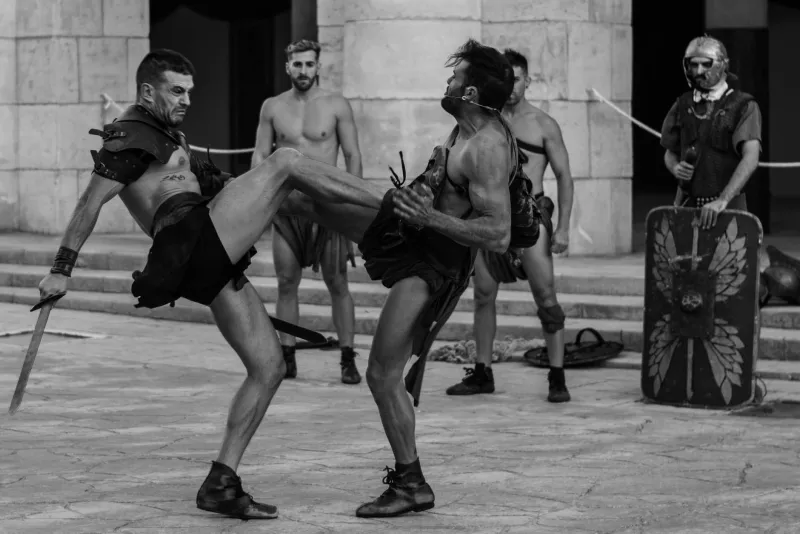
I Trained Like an MMA Fighter for 90 Days. Here's What Actually Happened to My Body and My Ego.

I Trained Like an MMA Fighter for 90 Days. Here's What Actually Happened to My Body and My Ego.
Let me be straight with you from the jump: I was not built for this.
Thirty-four years old. Desk job. The most athletic thing I'd done in the previous two years was a half-hearted attempt at a Peloton subscription that lasted six weeks. I wasn't overweight, exactly, but I was soft in the way that American office workers get soft — the kind of soft where you can convince yourself you're fine until someone asks you to do ten burpees.
I walked into a legitimate MMA gym in suburban Ohio on a Tuesday in January, paid for a three-month beginner's membership, and told myself I was going to document everything honestly. No cherry-picking the good days. No hiding the embarrassing parts. Here's what ninety days of real training actually looks like when you're starting from nothing.
Week One: The Humbling Is Immediate
The first class was a fundamentals session — supposedly the entry-level, nobody-gets-hurt introduction to the gym. Within twelve minutes I was on the mat, breathing like a dying animal, watching a sixteen-year-old kid flow through a shadow boxing drill with the casual ease of someone who'd been doing this since he could walk. Which, I later learned, he basically had.
The coach — a compact guy named Marcus with cauliflower ear so developed it looked architectural — didn't coddle me. He corrected my stance, told me my jab looked like I was "trying to hand someone a pamphlet," and moved on. That's the thing nobody tells you about real martial arts gyms: the instruction is often blunt to the point of feeling rude if you're coming from a fitness culture that's built around positive reinforcement.
By Friday of week one, my shins felt like someone had taken a baseball bat to them (just from bag work — I hadn't even sparred yet), my hips were screaming, and I'd discovered muscles in my forearms I genuinely didn't know existed.
I also loved it. Unreasonably, stupidly loved it.
The Gym Hierarchy Is Real — But It's Not What You Think
Every combat gym has a pecking order, and walking in as a raw beginner means you are definitively at the bottom. But here's the thing I didn't expect: the hierarchy isn't really about dominance. It's about knowledge.
The experienced guys and women in the gym — the ones with the worn gear and the economy of movement that makes everything look effortless — weren't hostile to beginners. They were just... elsewhere. Operating on a different frequency. When a purple belt in BJJ rolled with me during open mat in week three, he spent the entire round teaching rather than submitting me repeatedly, which he absolutely could have done. He tapped me out exactly once, explained what I'd done wrong, and reset.
That's the culture I found, anyway. I've heard horror stories about gyms that eat beginners alive. Mine wasn't that. But you do have to earn your place in the conversation, and that takes time and genuine effort. Show up inconsistently or with a bad attitude and the veterans will simply ignore you. Show up every day and work hard and they'll start talking to you. That's the unwritten contract.
Weeks Four Through Seven: The Wall
Around the one-month mark, the initial excitement wore off and I hit what I can only describe as a grinding, demoralizing plateau. My technique wasn't improving fast enough to feel rewarding, I was exhausted all the time, and I got a rib contusion during a sparring session that made deep breathing painful for two weeks.
This is where most people quit. I know this because Marcus told me directly: "The month-one dropout rate is brutal. People think they want to be fighters until they find out what fighters actually do."
What kept me going was partly stubbornness and partly something harder to name — a sense that there was a version of myself on the other side of this wall that I genuinely wanted to meet. The warrior-within mythology that combat sports culture sells? It felt like nonsense in week five. But the idea that difficulty itself was building something real? That landed.
I also started sleeping better than I had in years. Genuinely, profoundly well. The physical exhaustion was so complete that my chronic low-grade anxiety — the ambient hum of modern American professional life — went quiet. That alone was worth the rib.
The Physical Transformation: Honest Numbers
By the end of ninety days I'd lost eleven pounds, but more meaningfully I'd shifted composition in ways the scale didn't fully capture. My shoulders and back were noticeably different. My resting heart rate dropped from 72 to 61. I could do things with my body that had been impossible in January — not impressive things by any fighter's standard, but real things.
More surprising was the neurological adaptation. Movements that had required conscious thought in week one started happening automatically. My hands came up defensively without me deciding to raise them. I started reading body language differently — not just in the gym, but everywhere. There's a spatial awareness that develops when you spend hours trying not to get hit. It bleeds into daily life in strange ways.
What the Mythology Gets Wrong
Here's my honest assessment of the "warrior within" narrative that MMA culture loves to sell: it's not entirely wrong, but it's dramatically oversimplified.
The idea that combat training unlocks some primal, authentic self? There's something to it — but what it actually unlocks is mostly just discipline and physical competence, which aren't mystical. They're the result of showing up and doing hard things repeatedly. The transformation is real. The magic isn't.
What I found inside a real MMA gym wasn't a hidden warrior. I found a community of people who'd chosen to engage with difficulty voluntarily — some for competition, some for fitness, some for reasons they probably couldn't fully articulate. The shared experience of getting punched in the face (metaphorically and occasionally literally) creates a specific kind of bond. It's not mystical. It's just real.
Would I Do It Again?
I'm still training. That should answer the question.
If you're sitting on the fence about walking into a combat gym, here's my genuine advice: go find a place with good coaching, show up humble, expect to be uncomfortable for longer than feels reasonable, and give it at least sixty days before you decide anything.
The fist you lose in the process of learning this stuff — your ego, your comfort, your assumptions about what you're capable of — turns out to be exactly the thing you needed to drop.
That's the Lost Fist. And finding out what's on the other side of losing it? Completely worth it.