Ghost Techniques: The Deadly Fighting Arts That Vanished From History (And Why Warriors Are Hunting Them Down)
There's something uniquely haunting about a fighting style that no living person can fully demonstrate. Not a technique that got phased out because something better came along — but one that simply disappeared. Swallowed by war, locked away by secretive masters, or buried with the last practitioner who truly understood it.
At Lost Fist, we're obsessed with the idea that the greatest battles aren't always fought in cages or arenas. Sometimes they're fought against time itself. These are the ghost techniques — combat arts that warriors today would give almost anything to recover.
1. Pankration's Ground Game: The Original Submission Art
Most combat sports fans know that Pankration — the ancient Greek all-in fighting system — was basically proto-MMA. But what gets glossed over is how sophisticated the ground fighting apparently was. Ancient accounts and pottery illustrations suggest Greek Pankratiasts had developed leg locks, chokes, and positional control that wouldn't look out of place in a modern grappling tournament.
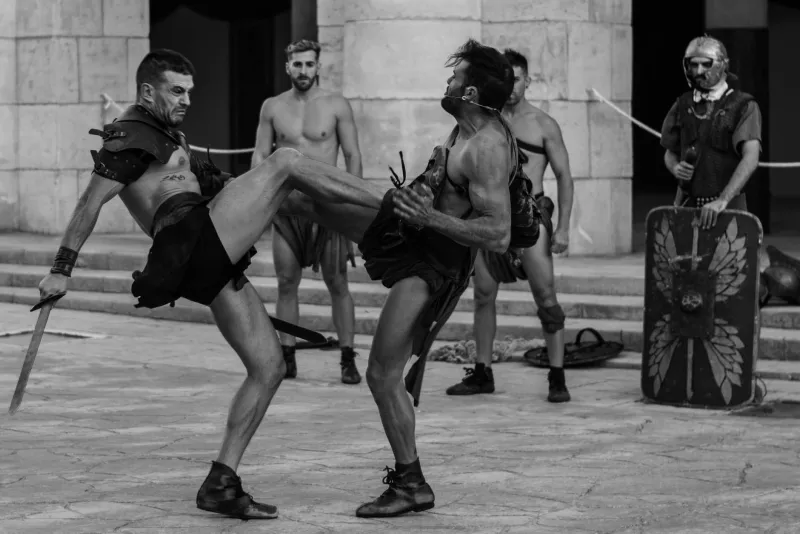
The problem? When Rome absorbed Greek culture and eventually outlawed the games, the practical transmission of Pankration died with the gladiatorial era. What we have left are fragmented descriptions and artwork that researchers like Jim Arvanitis have spent decades trying to decode. Arvanitis essentially rebuilt a version of Pankration from scratch, but even he admits the ground game is the biggest gap. Nobody knows exactly what those finishing techniques looked like in real-time execution.
2. Dim Mak: Myth, Medicine, or Murder?
Few techniques in martial arts lore carry more mystique — or more skepticism — than Dim Mak, the so-called "death touch" from Chinese martial traditions. The concept involves striking specific pressure points in precise sequences to cause delayed injury or death. In pop culture, it's pure fantasy. In serious martial arts circles, it's... complicated.
The truth is that Dim Mak was likely rooted in genuine anatomical knowledge developed alongside Traditional Chinese Medicine. Certain strikes to nerve clusters or arterial points absolutely cause real physiological disruption. But the elaborate sequential pressure point theory? That knowledge, if it ever existed in a codified form, appears to have been deliberately fragmented by masters who feared its misuse — passed down in pieces to different students, with no single person holding the complete picture. Modern researchers like Erle Montaigue spent years attempting reconstruction, but the methodology was always contested.
3. Catch-as-Catch-Can's "Hooks"
Early Catch Wrestling — the brutal carnival and mining camp grappling system that dominated American combat sports before boxing took over — had a repertoire of finishing holds that modern wrestling and even MMA has never fully recovered. Old-timers called some of the nastiest ones simply "hooks," and accounts from the late 1800s describe techniques that could end a match in seconds with joint damage that required surgery.
When professional wrestling went theatrical in the mid-20th century, the legitimate submission game went underground. A handful of coaches — Karl Gotch, Billy Robinson, Lou Thesz — kept embers alive. But even their students acknowledge that certain finishing sequences from the carnival era were never written down and died with their originators. Josh Barnett and a small community of modern practitioners are actively working to piece together what's left, but gaps remain.
4. Silat's Killing Forms
Pencak Silat, the indigenous martial art of Indonesia and Malaysia, is one of the most visually striking combat systems on earth. What most people don't know is that traditional Silat had distinct combat tiers — performance forms for festivals, fighting forms for competition, and then a third, deeply restricted layer intended only for actual life-or-death situations.
Those killing forms were guarded with extraordinary secrecy. Transmission was oral, often symbolic, and restricted to trusted family members. As colonialism disrupted traditional power structures across Southeast Asia and modernization changed social dynamics, many of those lineages simply broke. The masters died without passing on the complete system. Contemporary Silat schools openly acknowledge this loss, describing it as a wound in their tradition.
5. Khridoli: Georgia's Forgotten Wrestling System
Most Americans have never heard of Khridoli, and that's exactly the problem. This ancient Georgian martial art — developed in the Caucasus region over more than a thousand years — was a complete combat system blending striking, wrestling, and weapons work. It was effectively suppressed during the Soviet era, when regional cultural practices were homogenized or outright banned.
By the time the Soviet Union collapsed, Khridoli existed only in fragments preserved by a handful of elderly practitioners. Georgian martial arts organizations have been in active recovery mode since the 1990s, but reconstructing a complete fighting system from partial records and aging memories is an enormous challenge. What's been recovered is compelling. What's been lost may be irretrievable.
6. Lethwei's Pre-Colonial Techniques
Myanmar's Lethwei — bareknuckle full-contact fighting — has seen a global surge of interest in recent years, and for good reason. It's one of the most savage combat sports still practiced. But traditional Lethwei masters will tell you that the modern sport is a shadow of the pre-colonial system, which included techniques specifically designed for battlefield application that were stripped out when the British formalized and regulated the practice in the 19th century.
Those battlefield applications — targeting vulnerable anatomy in ways that modern sport rules prohibit — exist now only in the oral traditions of a small number of rural Burmese families.
7. Bartitsu: The Victorian Street System That Almost Was
Edwardian England produced one genuinely fascinating hybrid combat system: Bartitsu, developed by Edward William Barton-Wright around 1898. It combined Judo, boxing, savate, and stick fighting into a practical self-defense system that was arguably ahead of its time. Then Barton-Wright's school closed in 1903, and Bartitsu essentially vanished — so completely that Arthur Conan Doyle misspelled it as "Baritsu" when referencing it in a Sherlock Holmes story.
A dedicated community of historical martial arts researchers has spent the last two decades reconstructing Bartitsu from surviving journals and photographs. It's one of the more successful recovery projects, but practitioners are candid: the live sparring culture that would have refined and validated the techniques is gone forever.
The Hunt Continues
What makes these lost techniques so compelling isn't just the mystery — it's the genuine possibility that humanity developed effective combat solutions that we've since forgotten. Modern MMA has produced extraordinary fighters, but the assumption that we've discovered everything worth knowing about human combat is almost certainly wrong.
The warriors hunting these ghost techniques aren't chasing fantasy. They're doing something deeply human: refusing to let hard-won knowledge disappear without a fight. At Lost Fist, we think that's a battle worth respecting.
The fist may be lost. But the search? That never ends.