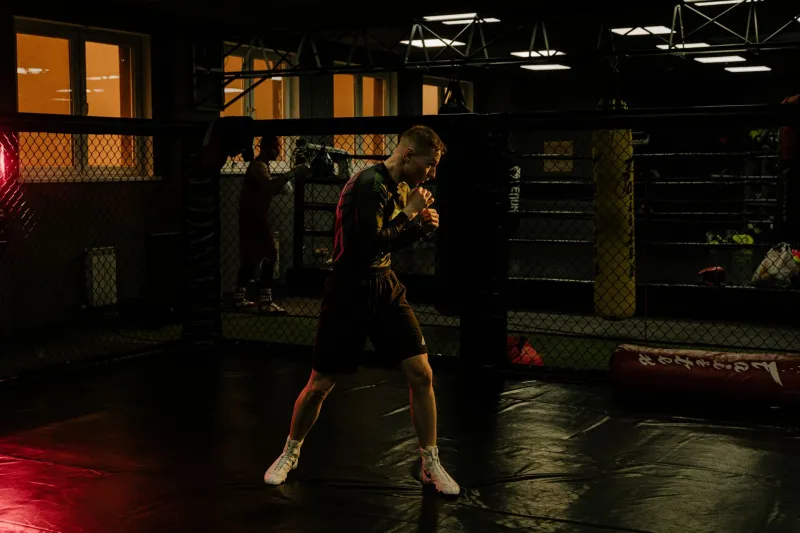
Faster Than Thought: Inside the Neuroscience of Why Certain Fighters See the Fight Before It Happens
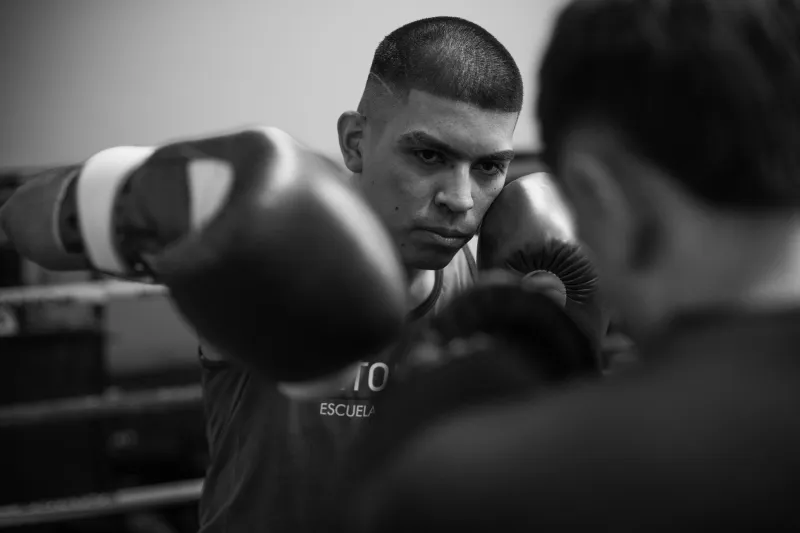
Watch enough high-level combat sports and you'll eventually see it — that moment when a fighter appears to respond to an attack before the attack has fully launched. The slip that comes a half-second too early to be a reaction. The counter that lands before the original punch has finished traveling. The takedown defense that engages at the exact moment of the shot, not a frame later.
From the outside, it looks like a kind of magic. From the inside, according to the fighters who experience it, it feels like the world slowing down.
Neuroscientists have a more precise description. And what they've found about how elite combat athletes process information is genuinely strange — and has implications that go well beyond sports.
The Millisecond Problem
Human reaction time, in the most basic laboratory sense, averages somewhere between 150 and 300 milliseconds for a simple stimulus. See a light, press a button. That's the baseline.
In combat, the math gets brutal fast. A trained boxer's jab travels roughly 25 miles per hour from a standard fighting stance. At that speed, a punch thrown from four feet away arrives in well under 200 milliseconds. That's shorter than the average human reaction time. Which means, technically speaking, you cannot react to a punch that's already been thrown. Not consciously. Not in time.
And yet elite fighters do it constantly. So what's actually happening?
Anticipation, Not Reaction
The short answer is that elite fighters aren't reacting to what's happening. They're anticipating what's about to happen — and their brains have been trained to do this so efficiently that it operates largely outside conscious awareness.
Researchers who study expert performance in combat sports use the term "anticipatory cuing" to describe the process. Elite fighters read pre-movement signals — subtle shifts in a opponent's weight distribution, micro-tensions in the shoulders, changes in eye focus, alterations in breathing rhythm — and begin processing a response before the attack has actually launched.
This is fundamentally different from reaction time. It's pattern recognition operating at a speed and depth that years of competitive experience builds into the neural architecture of the brain.
"What we're seeing in elite athletes isn't faster reaction," explained one sports neuroscientist who has studied combat athletes specifically. "It's earlier information gathering. They're not responding to what happened. They're responding to what's about to happen, based on information the rest of us don't even know we're supposed to be reading."
The Role of the Unconscious Brain
Here's where the neuroscience gets genuinely interesting. A significant portion of a fighter's in-combat decision-making doesn't pass through conscious awareness at all. The prefrontal cortex — the part of the brain associated with deliberate reasoning and decision-making — is far too slow for the demands of live combat.
What elite fighters are doing instead is operating primarily through the basal ganglia and cerebellum, brain regions associated with procedural memory and automated skill execution. These systems can process and execute complex motor responses in timeframes that conscious thought simply cannot access.
The practical implication is striking: the best fighters in the world are, in a meaningful sense, thinking less during combat than their less-skilled counterparts. They've moved so much of their tactical vocabulary into automatic processing that their conscious minds are freed up to handle higher-level strategic decisions — while the moment-to-moment tactical responses happen below the threshold of deliberate thought.
Is This Trainable or Are Some Brains Just Built Different?
This is the question that matters most to coaches and fighters, and the honest answer is: both, and the interaction between them is complicated.
Research on expert performance across domains — not just combat sports, but chess, music, surgery — consistently shows that a massive volume of deliberate practice is required to build the kind of deep pattern recognition that elite fighters demonstrate. The number most commonly cited in cognitive science is in the range of ten thousand hours of focused, effortful practice before genuine expertise emerges. There are no shortcuts to building the neural library that makes anticipatory cuing possible.
But the research also shows that individuals vary significantly in how efficiently they build these neural patterns. Some people encode procedural memories faster. Some people are naturally more sensitive to the kind of subtle social and physical cues that translate into reading opponents. Some brains, for reasons that are still being studied, seem to integrate information across sensory modalities more fluidly than others.
"You can train anyone to get significantly better at this," said one fight analyst who consults with professional training camps. "But the ceiling varies. Some fighters hit a certain level and plateau. Others keep developing this capacity well past the point where you'd expect them to stop improving. That's not just training. That's something structural."
What This Means for How Fighters Train
The practical applications of this research are starting to filter into how serious training camps approach skill development — particularly in the US, where a growing number of coaches are incorporating cognitive training alongside physical preparation.
Scenario drilling, where fighters practice responding to specific attack sequences until the response becomes truly automatic, is the most direct application. The goal isn't to teach fighters what to do in a given situation. It's to automate the response so completely that it doesn't require a decision at all.
Perceptual training — exposing fighters to video of opponents and training them to identify pre-movement cues — is another approach gaining traction. Some camps use eye-tracking technology to identify exactly where fighters are looking during sparring and competition, then deliberately restructure their visual attention patterns to pick up more relevant information earlier.
Mindfulness and attentional control work is increasingly common as well. The ability to stay in a state of relaxed, open awareness — rather than tightening up cognitively under pressure, which is the enemy of fast pattern recognition — turns out to be a trainable skill with real performance implications.
The Fighters Who Operate on Another Level
Some of the most compelling anecdotal evidence for the neuroscience comes from fighters themselves, describing what high-level competition actually feels like from the inside.
The "slow motion" experience — where the fight seems to decelerate during peak performance states — is reported by elite combat athletes across virtually every discipline. What the neuroscience suggests is that this isn't actually about time slowing down. It's about information processing accelerating. When the brain is working at maximum efficiency, it's encoding more sensory data per unit of time. The subjective experience of that is the world appearing to move more slowly.
"It doesn't happen every fight," said one veteran mixed martial artist. "But when it does, you just know what's coming. Not because you thought about it. You just know. And your body is already moving."
That's not magic. That's a brain that has been built, through thousands of hours of deliberate, high-quality practice, into something that processes combat information faster than conscious thought can follow.
The lost fist isn't always the one thrown hardest. Sometimes it's the one that was already moving before the other fighter decided to attack — guided by a nervous system that has learned, over years of relentless training, to read the future one millisecond at a time.