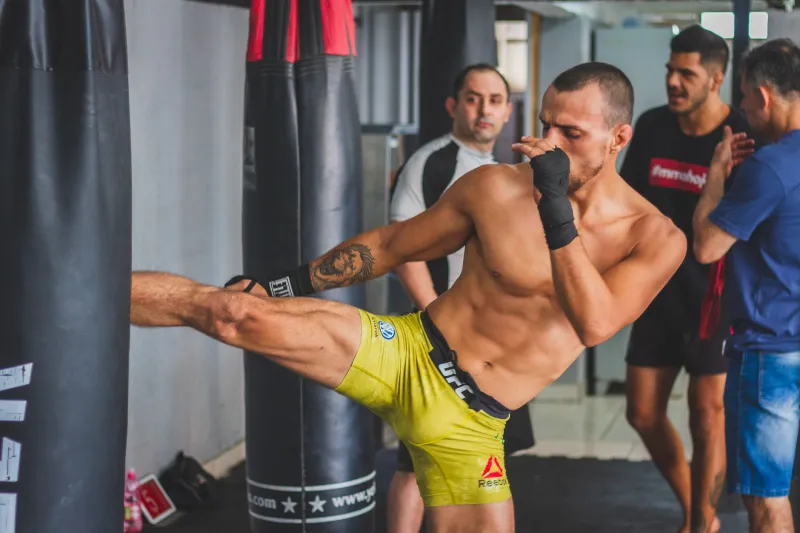
Broken and Rebuilt: The Fighters Who Came Back Harder After Medicine Said No

There's a moment every seriously injured fighter knows. It comes somewhere between the MRI results and the follow-up appointment, when a doctor — a good one, maybe even a great one — leans forward and uses words like permanent and realistic expectations and quality of life going forward. The room gets very quiet. And somewhere in that silence, a decision gets made.
For most people, that decision is acceptance. For a certain kind of fighter, it's something else entirely.
When the Body Becomes the Enemy
Catastrophic injuries in combat sports don't get enough honest coverage. We see the knockout highlight, the dramatic stretcher exit, maybe a social media post six months later with a brace and a thumbs-up. What we don't see is the eighteen months in between — the nerve pain that wakes you at 3 a.m., the atrophied muscle that used to throw 200-pound men across a mat, the psychological freefall of not knowing who you are without the fight.
Take the case of fighters dealing with lumbar fractures — breaks in the lower spine that, depending on severity, can end careers before a surgeon finishes explaining the imaging. Conventional medicine often recommends fusion surgery followed by conservative rehabilitation and, in the same breath, a conversation about transitioning out of combat sports. A significant number of fighters hear that and quietly start planning their return anyway.
It's not delusion. Or at least, it's not only delusion. It's a calculated gamble made by people who've spent years learning exactly what their bodies can and can't do — people who, frankly, have a different relationship with pain than most of us will ever understand.
The Underground Support Network
Here's something the mainstream sports medicine world doesn't fully account for: fighters talk to each other. Constantly. And when someone goes down hard, that informal network activates in ways that no official rehab protocol captures.
There are strength and conditioning coaches who've quietly rebuilt fighters the medical system wrote off. Physical therapists who work out of small private practices — not affiliated with any promotion, not bound by any liability-conscious institutional caution — who've developed protocols specifically for combat athletes that go well beyond standard post-surgical guidelines. Former fighters turned coaches who've been through their own reconstructions and know the difference between pain that means stop and pain that means keep going carefully.
This isn't recklessness dressed up as expertise. The best of these practitioners are genuinely skilled, just operating in a space where the stakes are understood differently. A fighter coming to them isn't a liability. They're a project, and everyone involved knows the score.
The financial side is worth mentioning too. Most of these comebacks happen outside the support structure of major promotions. Independent fighters, regional circuit guys, athletes who never made enough to have real savings — they're funding their own recoveries through part-time work, crowdfunding from their training community, or quietly borrowing from people who believe in them. The comeback isn't just physical. It's a full-life financial and logistical grind that most spectators never see.
The Psychology of Rebuilding
Sports psychologists will tell you that injury recovery has a predictable emotional arc: shock, grief, bargaining, adaptation. What they're less equipped to explain is what happens when a fighter reaches adaptation and the adapted version of themselves turns out to be better than the original.
It sounds like motivational-poster nonsense until you hear fighters describe it in their own words. There's something that happens when you've genuinely lost something and clawed it back — a clarity about what matters, a patience that didn't exist before, a technical refinement that comes from no longer being able to rely on the physical attributes that used to carry you. Fighters who return from catastrophic injury often report that they had to actually learn their craft in ways they never needed to before the injury.
A wrestler who blew out both knees and spent two years off the mat comes back having drilled nothing but upper-body control and positional awareness. A striker who suffered nerve damage in their dominant arm develops their off-hand into a genuine weapon. The injury, perversely, closes off bad habits and forces a kind of technical evolution that might never have happened otherwise.
Not everyone makes it back. That's the part that gets lost in the comeback narratives we celebrate. For every fighter who returns to competition after a broken back, there are others who tried just as hard and couldn't get there — whose bodies, no matter how willing the mind, simply couldn't close that gap. The ones who make it aren't necessarily tougher or more deserving. They're also, sometimes, just luckier.
What the Return Actually Looks Like
The first competition back after a catastrophic injury is almost never pretty. Fighters describe a strange doubling of consciousness — one part of the brain trying to compete, another part monitoring the rebuilt body with a kind of hypervigilance that doesn't fully go away for months. Every awkward landing, every scramble, every moment of unexpected impact gets flagged and assessed in real time.
And yet, fighters come back. They win matches. They get on regional cards. Some of them — the rare ones — make it back to the level they were at before, or close enough that the difference only matters to them.
What drives that? It's not money, usually. It's rarely fame at the regional level. It's something harder to articulate — a need to close a loop, to prove something to themselves that no one else can validate for them. The fight, for these athletes, isn't really against an opponent. It's against the version of events where they stayed down.
The lost fist in this story isn't the one that got hurt. It's the one that came back swinging anyway — slower maybe, smarter definitely, and carrying something that wasn't there before. Call it scar tissue. Call it wisdom. Either way, it hits harder than you'd expect.