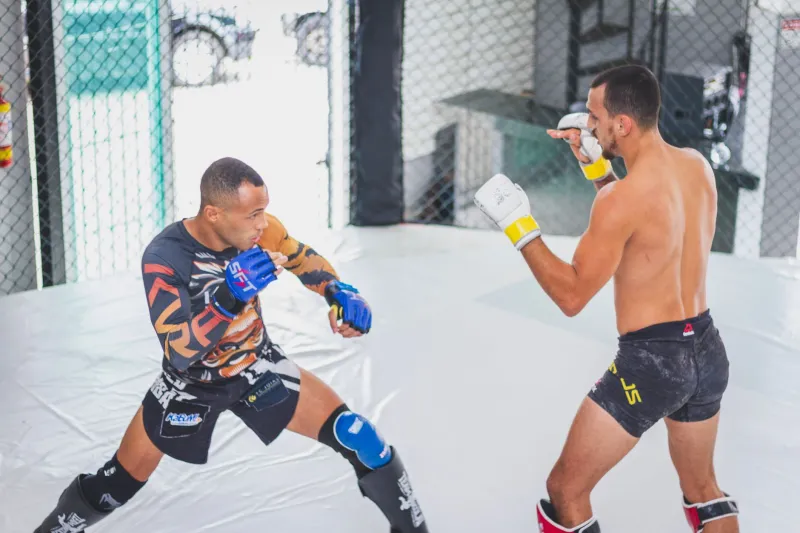
Still Standing: The American Fighters Defying Age — and Winning Professional Bouts Past 40

There's a version of this story that gets told all the time in combat sports. A fighter hits 38, maybe 39, and the promoters stop calling. The sparring partners get a little too fast. The recovery between hard sessions stretches from two days to four. Eventually, the fighter hangs it up, maybe opens a gym, maybe just fades out — and the sport moves on without looking back.
Then there's the other version. The one where the fighter doesn't quit.
Across MMA, boxing, and kickboxing circuits in the United States, a quiet but undeniable phenomenon has been building for years: professional fighters in their 40s and even 50s who aren't just showing up — they're winning. Not squeaking by on judges' scorecards against soft opposition, either. Legitimate victories. Stoppages. Title fights. These are warriors who rewrote the terms of their own contracts with time, and they've got the records to prove it.
This isn't a story about nostalgia. It's a story about what it actually costs to keep competing when the world has already written your obituary.
The Numbers Don't Lie — But They Don't Tell the Whole Story
Boxing has always had its late-career outliers. Bernard Hopkins famously defended a light heavyweight title at 49 years old, and while his style was built on chess rather than athleticism, the wins were real. Shane Mosley was still competing at a high regional level into his mid-40s. Jeff Lacy, once considered one of the most fearsome punchers in super middleweight boxing, returned to the ring after 40 and kept finding ways to get his hand raised.
In MMA, the numbers are newer but just as striking. Randy Couture captured the UFC heavyweight championship at 43. Dan Henderson — one of the most respected fighters in the sport's history — was still competing at the highest levels of Bellator MMA at 41, 42, 43. His chin wasn't what it used to be, but his timing, his game planning, and his sheer refusal to concede an inch made him dangerous until the final bell of his career.
At the regional and semi-professional level, the over-40 fighter is becoming less of an anomaly and more of a legitimate archetype. Walk into a regional MMA event in Texas, Ohio, or the Pacific Northwest on any given weekend, and you'll find grizzled veterans with graying temples and spotless footwork picking apart opponents half their age.
So what's actually going on?
Training Smarter, Not Just Harder
The fighters who survive into their 40s almost universally describe the same fundamental shift: they stopped training like they were 25.
That sounds simple. It isn't.
For most fighters, the culture of combat sports is built around volume, intensity, and proving yourself every single session. You go hard. You spar hard. You push through soreness because that's what warriors do. That approach works when your body recovers in 48 hours. It becomes a slow-motion disaster when recovery takes a week and the next hard session is already scheduled.
Older competitive fighters tend to replace high-volume sparring with high-quality sparring — fewer rounds, more specific, with trusted partners who understand the assignment. They invest heavily in mobility work, soft tissue maintenance, and sleep in ways that younger fighters often dismiss as soft. Nutrition becomes less about cutting weight and more about actual fueling. The gym sessions get shorter and more deliberate.
The irony is that many of these veterans say they're technically better now than they were at 28. They've shed the ego-driven habits that got them hurt. They know exactly what they're good at, they've stopped trying to be something they're not, and they've built a fighting style that works with their body instead of demanding things from it that it can no longer deliver.
The Mental Architecture of the Long-Career Fighter
Physical adaptation only explains part of the equation. The psychological dimension of competing professionally after 40 is something most fighters don't talk about openly — because it requires admitting things that feel uncomfortable in a culture that prizes invincibility.
You have to make peace with the fact that you're slower than you were. That's not a pep talk — that's just physiology. Fast-twitch muscle fibers decline. Reaction time slows marginally but measurably. A fighter who pretends otherwise is setting themselves up for a brutal education.
The veterans who keep winning have generally made a different kind of peace. They accept the physical realities without accepting defeat. They find edges elsewhere — in their ability to read opponents, to control pace, to manage rounds, to make the fight ugly when ugly is what the moment demands. Experience becomes a weapon in a way that pure speed never could be, because experience compounds over time instead of eroding.
There's also the matter of motivation. Younger fighters are often running toward something — a title, a payday, a reputation. Fighters over 40 are frequently running from something: the idea that their best days are behind them, that they've already peaked, that the most meaningful chapter of their lives is over. That's a different kind of fuel, and it burns long.
What It Actually Costs
It would be dishonest to tell this story without sitting with the hard parts.
Fighting professionally past 40 is not without real physical consequence. The body accumulates damage in ways that don't fully heal. Chronic joint pain, hearing loss, and the long-term neurological concerns that shadow all contact sports become more pressing conversations as the years stack up. Families worry. Doctors advise caution. Athletic commissions in several states have begun implementing stricter protocols for older fighters — brain scans, extended medical reviews — that some fighters find insulting and others quietly acknowledge as necessary.
The personal cost is just as real. Training at a competitive level while holding down a career, raising kids, maintaining relationships — that's a juggling act that breaks most people in their 20s. Doing it in your mid-40s requires a level of support, discipline, and sacrifice that goes largely unacknowledged when the fighter's hand gets raised.
The fighters who make it work are almost always surrounded by people who believe in what they're doing. Coaches who adapt rather than abandon. Partners who understand the commitment. Training communities that see the veteran not as a cautionary tale but as living proof that the sport is bigger than any single timeline.
Why It Matters
The over-40 fighter is easy to dismiss. Easy to see as someone who can't let go, who's chasing something they should have surrendered years ago. That reading is lazy and, frankly, a little cowardly.
What these competitors are actually doing is something more complicated and more interesting. They're testing a hypothesis — that the conventional wisdom about peak performance in combat sports is more cultural than biological, more convenient than true. And every time one of them walks out of a cage with a win, they add another data point to the argument.
They're also, whether they intend to or not, redefining what it means to be a warrior in middle age. Not the slow, nostalgic version. Not the sad, overstaying-their-welcome version. The real version — still sharp, still dangerous, still writing their own story on their own terms.
The fist isn't lost. It's just taken longer to find its target.
And when it lands, it still lands hard.